Budget 2026 to have marginal impact on bond markets
2 min read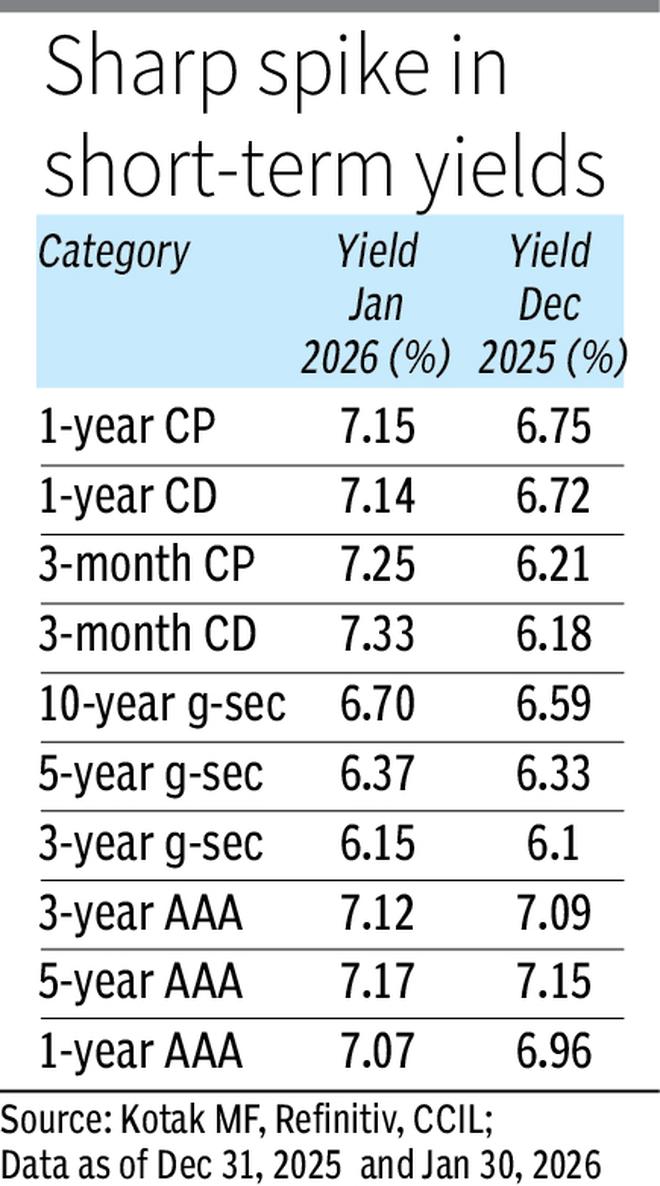
Continuing its path of fiscal consolidation, Budget 2026 projected a fiscal deficit of 4.4% for FY26, with plans to reduce it further to 4.3% in FY27. The transition to a debt-to-GDP framework shows current levels at 56.1% for FY26, anticipated to decline to 55.6% in FY27. This trajectory aligns with the government’s target of achieving a 50% debt-to-GDP ratio by 2030.
Market borrowing figures appear elevated, with gross market loans projected at ₹17.2 lakh crore for FY27 – a 17.7% increase over FY26 revised estimates. The government plans to raise ₹3.87 lakh crore through small savings schemes in FY27, exceeding FY26’s revised estimate of ₹3.72 lakh crore by 8%.
Overall, the budget presents a neutral to slightly negative outlook for bond markets.
Distinct market forces
Recent months witnessed significant yield spikes across short-term instruments. Three-month commercial paper yields rose 104 basis points to 7.25%, while certificate of deposit yields climbed 115 basis points to 7.33% within a month. Longer-term one-year instruments also saw increases of 40-42 basis points, reaching 7.14-7.15%, according to Kotak MF data sourced from Refinitiv and CCIL.

Multiple factors contribute to this environment including elevated credit-deposit ratios exceeding 82%, institutional tenor mismatches, foreign portfolio outflows, and RBI foreign exchange interventions. Record-high currency circulation (₹39.8 lakh crore as of January 15, 2026) and rising state development loan yields exacerbate banking system liquidity constraints.
Market analysts anticipate normalization as liquidity measures take effect and structural factors stabilize. The yield curve behavior has shifted dramatically from steepening trends to inverted conditions where shorter tenors exceed longer-term yields.
Given the persistent high yields exceeding 7% across short and medium durations, investors may consider allocations to money market instruments and select corporate debt funds with durations under five years.
Published on February 1, 2026
About Author


