Beyond the Podium: Why the Future of Impact is Co-Owned, Not Presented
By Amita Nene | RISE PECOWorld Summit 2026 Coverage
QUICK SUMMARY
After 12 years, 84 countries, and 30,000 participants, the RISE Peco
World Summit 2026 is moving beyond panels and presentations toward a
model of co-owned social impact.
The summit’s PECO framework replaces legal-status labels (NGO,
government, industry, academia) with three action-based personas —
Entrepreneur, Citizen, and Partner — and reframes wealth around human,
social, physical, and natural capital, not just money.
We have all been there: sitting in a dimly lit conference hall, watching
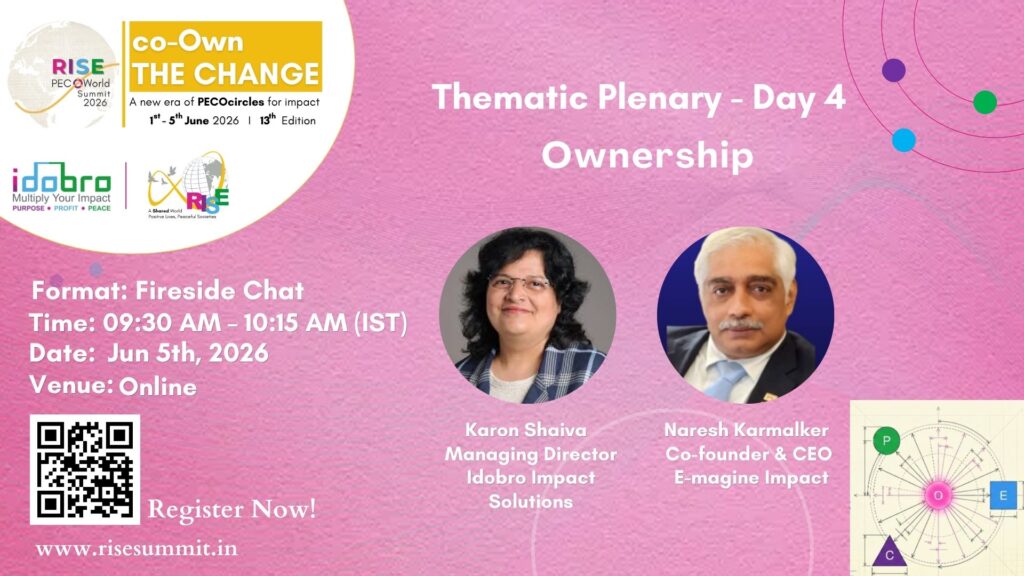
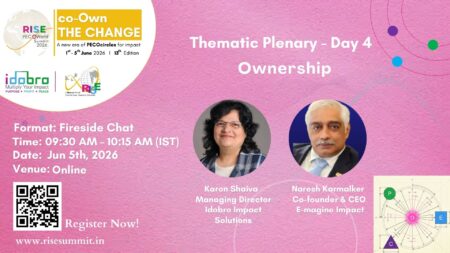
a speaker read bullet points off a screen in a phenomenon Karon Shaiva
aptly describes as “Death by PPT.” For decades, the social impact sector
has relied on these traditional convenings — panels and presentations
that facilitate conversation but often fail to catalyse action. But
dialogue has reached a point of stagnation. After 12 years, 84
countries, and 30,000 participants, the RISE PECOWorld Summit has
reached a critical realisation: conversation alone has hit the law of
diminishing returns.
The RISE PECOWorld Summit 2026 represents a radical evolution. It is a
shift from “breakthrough interactions” to a model of co-ownership. It
moves us past the “wow factor” of a good speech and toward a gritty,
functional mantra: the world is fixable; the coalition is the solution.
To fix it, we must stop being spectators and start being stewards.
“The world is fixable, the coalition is the solution. That is co-owned.”
1. Moving from Dialogue to Co-Owned Change
After a decade of summits, the organisers recognised a shift in the
sector’s needs. While the first ten years were defined by successful
interactions, the law of diminishing returns suggested that merely
talking about problems was no longer generating new value. To avoid the
trap of repetitive discourse, the summit evolved into a platform for
building a coalition rather than just a forum for ideas.
The goal is no longer just to have a breakthrough dialogue; it is to
build a coalition that co-owns the change. In this paradigm,
conversation is merely the starting point. True impact occurs when
stakeholders move into a space of co-ownership, where the responsibility
for success — and the risk of failure — is shared across an entire
ecosystem.
2. The PECO Persona: Redefining Identity Through Action
The most radical shift in the RISE model is the move away from legal
identities. Traditionally, stakeholders are categorised by tax status —
NGO, government, industry, or academia — and rigid expectations get
projected onto them based on those titles.
The PECO model disrupts this by focusing on willingness to act rather
than legal status. It moves the sector from the myth of the “lone heroic
leader” toward a model of intellectual leadership, where impact is
distributed across three personas:
01 The Entrepreneur
The builder of solutions and innovations. This persona is defined by a
mindset of filling gaps and solving problems.
02 The Citizen
The carrier of trust. These individuals are the information and
influence hubs of community networks, ensuring solutions are not just
technically sound but culturally accepted and trusted.
03 The Partner
The steward of resources — individuals or entities that provide the
capital needed to scale a proof of concept. Identifying which persona
one embodies allows contribution based on unique strengths rather than
the constraints of a job title.
3. Partnership as Radical Stewardship
The summit introduces a definition of partnership that is fundamentally
at odds with the transactional “what’s in it for me?” mindset common in
many sectors, where a partner is simply a vendor or a joint-venture
investor.
In the PECO context, partnership is an act of relinquishing control —
the willingness to offer resources for use by others, based on a humble
question: can you use this more effectively than I can? This is
stewardship in its purest form, viewing one’s expertise, networks, or
capital as tools for the common good rather than assets for personal or
organisational leverage.
“Partnership is really about giving your resources to others to use…
It’s not about what’s in it for me, but to say, can you use this more
effectively than I can?”
4. The Koru Philosophy: Staying Rooted in “Ancient Futures”
To sustain this work, the summit uses the Koru Toolkit — a framework for
social change that bridges tradition and innovation, a concept the
organisers call “Ancient Futures.” The Koru symbol has two parts: one
opening outward, symbolising growth, new beginnings, and prosperity; and
one curling inward, representing the need to stay rooted in tradition
and values.
This philosophy holds that modern social models must remain rooted in a
specific value system to achieve lasting peace and prosperity. For the
RISE community, these are the RISE Values: Responsible, Inclusive,
Sustainable, and Ecosystem-friendly. True progress is not about
abandoning the past, but about staying rooted in these values while
growing outward into new, modern solutions.
5. Beyond Financial Capital: Building Intergenerational Wealth
A pervasive myth in the development sector is that without money,
nothing can be done. The summit dispels this by shifting focus toward
intergenerational wealth — wealth measured not in currency, but in the
health of a society and its environment.
While financial capital is a tool, the PECO framework emphasises four
other forms of capital that often exist in abundance even when funds are
low:
1. Human Capital — Expertise and Labor
2. Social Capital — Trust and Networks
3. Physical Capital — Infrastructure and Tools
4. Natural Capital — The Environment and Resources
The objective of financial capital should be its strategic deployment to
build these other four forms. When social and natural capital are
prioritised, the result is wealth that lasts for generations rather than
funding for a single project cycle.
Traditional Convening vs. the RISE PECO Model
Dimension Traditional Convening Model RISE PECO Model
Basis of contribution Legal status (NGO / government / industry /
academia) Willingness to act — the PECO persona
Guiding mindset Transactional: “What’s in it for me?” Stewardship: “Can
you use this more effectively than I can?”
Primary capital in focus Financial capital Human, social, physical, and
natural capital
Format Panels and presentations (“Death by PPT”) Coalition-building and
shared delivery
Outcome sought A breakthrough dialogue Co-owned, intergenerational
change
Conclusion: A Call to Stewardship
The path from conversation to collaboration is structured. Through the
ABCD of coalitions — sign up, build the network, collaborate, and
deliver — the RISE PECOWorld Summit provides a roadmap to move beyond
the podium.
The ultimate mission is a simple but challenging command: go own the
change. The sector can no longer afford to be mere conversationalists;
the complexity of the world’s problems requires becoming collaborators
and stewards.
“If you have the expertise, lend it. If you have the time, spend it. If
you have a problem your community faces, bring it here.”
— Naresh Karmalker
As you look at the challenges in your own community, ask yourself: which
PECO persona do you embody today? Are you a builder of solutions, a
carrier of trust, or a steward of resources? The world is fixable — but
only if we are willing to co-own the solution.
Frequently Asked Questions
Q: What is the RISE PECOWorld Summit?
A: It is a global convening — now in its 12th year, spanning 84
countries and 30,000 participants — that has evolved from a
dialogue-driven event into a platform for building coalitions that
co-own social impact outcomes.
Q: What does the PECO persona model mean?
A: Instead of categorising participants by legal or organisational
status (NGO, government, industry, academia), the PECO model identifies
contributors by their willingness to act, sorting them into three roles:
the Entrepreneur, the Citizen, and the Partner.
Q: What are the RISE Values referenced at the summit?
A: RISE stands for Responsible, Inclusive, Sustainable, and
Ecosystem-friendly — the value system the Koru Toolkit uses to keep
social innovation rooted while it scales.
Q: What is the ABCD of coalitions?
A: It is the summit’s roadmap for turning conversation into
collaboration: Sign up, Build the network, Collaborate, and Deliver.
Disclaimer: This article is based on proceedings, frameworks, and
statements presented at the RISE PECOWorld Summit 2026. Views expressed
by individual speakers are their own and do not necessarily reflect the
editorial position of Newsbizkoot.com.
Copyright: Content is copyrighted to Newsbizkoot.com Digital
Publications. All Rights Reserved. 2026-27.
Thanks for subscribing!Please check your Email inbox for our Mail for the various Newsletters categpries, you will be receiving from us for on a Weekly basis until the person unsuncribes for it via the unsubscribe link in each Newsletters.
We use cookies to improve your experience, analyse site traffic, and personalise content. You can accept all cookies, manage your preferences, or reject non-essential cookies.
This website uses cookies
Websites store cookies to enhance functionality and personalise your experience. You can manage your preferences, but blocking some cookies may impact site performance and services.
Essential cookies enable basic functions and are necessary for the proper function of the website.
Name
Description
Duration
Cookie Preferences
This cookie is used to store the user's cookie consent preferences.
30 days
Google Tag Manager simplifies the management of marketing tags on your website without code changes.
Name
Description
Duration
cookiePreferences
Registers cookie preferences of a user
2 years
td
Registers statistical data on users' behaviour on the website. Used for internal analytics by the website operator.
session
Statistics cookies collect information anonymously. This information helps us understand how visitors use our website.
Google Analytics is a powerful tool that tracks and analyzes website traffic for informed marketing decisions.
Contains custom information set by the web developer via the _setCustomVar method in Google Analytics. This cookie is updated every time new data is sent to the Google Analytics server.
2 years after last activity
__utmx
Used to determine whether a user is included in an A / B or Multivariate test.
18 months
_ga
ID used to identify users
2 years
_gali
Used by Google Analytics to determine which links on a page are being clicked
30 seconds
_ga_
ID used to identify users
2 years
_gid
ID used to identify users for 24 hours after last activity
24 hours
_gat
Used to monitor number of Google Analytics server requests when using Google Tag Manager
1 minute
_gac_
Contains information related to marketing campaigns of the user. These are shared with Google AdWords / Google Ads when the Google Ads and Google Analytics accounts are linked together.
90 days
__utma
ID used to identify users and sessions
2 years after last activity
__utmt
Used to monitor number of Google Analytics server requests
10 minutes
__utmb
Used to distinguish new sessions and visits. This cookie is set when the GA.js javascript library is loaded and there is no existing __utmb cookie. The cookie is updated every time data is sent to the Google Analytics server.
30 minutes after last activity
__utmc
Used only with old Urchin versions of Google Analytics and not with GA.js. Was used to distinguish between new sessions and visits at the end of a session.
End of session (browser)
__utmz
Contains information about the traffic source or campaign that directed user to the website. The cookie is set when the GA.js javascript is loaded and updated when data is sent to the Google Anaytics server