The Connecting Link: How Maharashtra’s ₹7,000 Crore World Record Tunnel is Rewriting the Mumbai–Pune Drive
9 min read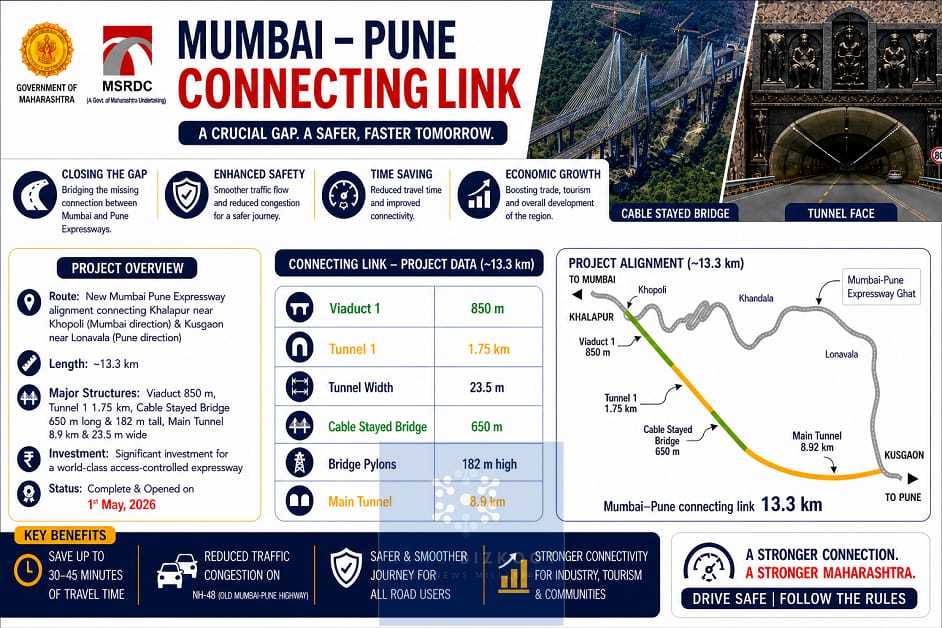
is Rewriting the Mumbai–Pune Drive
I’ve done the Mumbai–Pune drive more times than I can count. I know the drill. You leave Bandra at 6am hoping to beat the traffic, hit the Khalapur toll at 7:15, feel briefly smug — and then, somewhere between Khopoli and Adoshi, the road gets its revenge. The six-lane expressway quietly merges with the four-lane NH-48, ten lanes of traffic squeezing into six through hairpin bends and steep ghat gradients. Trucks doing 30 km/h. Tempos drifting lanes. The Lonavala exit backed up for four kilometres on a Sunday. You know exactly what this feels like.
On the morning of May 1, 2026 — Maharashtra Day — that particular punishment ended.
Maharashtra Chief Minister Devendra Fadnavis inaugurated the long-awaited Missing Link project on the Mumbai–Pune Expressway, opening what is now officially the world’s widest underground tunnel. And at the ceremony, he said something worth quoting exactly: “This should not be called a Missing Link but a connecting link. Nothing is missing. Everything is in place.”
He’s right. And this article is about why that reframing matters — not just as political rhetoric, but as a genuine description of what this infrastructure achievement actually does for the 75,000 vehicles that
use this corridor every single day.
The Problem This Tunnel Solves
To understand why the Connecting Link is a big deal, you need to understand the specific torture of the old ghat section. The existing Mumbai–Pune Expressway runs 94.5 km from Kalamboli in Navi Mumbai to Kiwale in Pune. For most of that distance it is genuinely excellent — wide, smooth, well-lit, with a safety record that has improved significantly since the Zero Fatality Corridor project launched in 2016.
But there is one section. The 19 km stretch from Khopoli exit to Sinhgad Institute, where the expressway climbs the Bhor Ghat through the Sahyadri range. Here, the expressway’s own six lanes merge with the four lanes of NH-48, creating an impossible situation: ten lanes of traffic trying to move through a six-lane mountain road full of curves, gradients, fog, and monsoon landslides.
Every disruption on that ghat section cascades across both cities. When a gas tanker overturned near the Adoshi tunnel in February 2026, the expressway was shut for 30 hours. Thirty hours. During the monsoon, landslides have triggered closures lasting days. And on any long weekend — Diwali, Eid, Christmas — the backup at Khandala stretches so far you can finish a podcast, eat a meal, and consider your life choices before you move a kilometre.
The Connecting Link bypasses this entire section.
What Was Built: The Engineering Numbers Let’s be specific about what MSRDC actually constructed here, because the scale of this project is genuinely jaw-dropping when you lay it out.
The new alignment is 13.3 km long — replacing the existing 19 km ghat route. It connects the Khopoli exit on the Mumbai side to Kusgaon (near Sinhgad Institute) on the Pune side, entirely bypassing the Khandala ghat. The project was divided into two packages:
Package I — The Tunnels: Twin tunnels, eight lanes total. The shorter tunnel runs 1.75 km. The longer one — the headline — is 8.92 km, built under Lonavala Lake, through 85 lakh tonnes of excavated Sahyadri rock. Each tunnel bore is 22.33 metres wide. That width is what earned the Guinness World Record: the world’s widest underground tunnel. The tunnels used 7,600 tonnes of steel in their construction and feature air quality sensors, ventilation systems, firefighting infrastructure, and
emergency exits at regular intervals. Speed inside: up to 120 kmph on a straight, well-lit corridor.
Package II — The Viaducts: Two elevated viaducts — one 790 metres long, one 650 metres — carrying eight lanes over the Tiger Valley on ultra-high-performance fibre-reinforced concrete girders. The
cable-stayed bridge rises 180 metres above the valley floor. Construction in this terrain meant working at serious height with significant wind loads. The engineering firm Afcons Infrastructure delivered the viaduct package; Navayuga Engineering built the tunnels.
Total project cost: ₹7,000 crore. Construction began in March 2019. It was originally due in March 2024, pushed to August 2025, and finally opened on May 1, 2026. Delays were real — complex terrain, COVID
disruptions, supply chain issues — but the result justifies every postponement.
What Changes for You: The Driver’s Experience
Distance saved: approximately 6 km on the total expressway length. Time saved: 25 to 30 minutes officially; closer to 45–60 minutes on a bad monsoon day when the ghat is at its worst. The new route replaces 19 km of winding gradient with 13.3 km of straight tunnel and elevated highway at speeds up to 120 kmph.
Here is what the comparative journey now looks like:
Route Segment Old Ghat Section New Connecting Link
Khopoli to Kusgaon 19 km, winding ghat, NH-48 merge, avg 60–80 kmph 13.3 km, tunnel + viaduct, up to 120 kmph
Typical travel time (off-peak) 20–25 minutes 10–12 minutes
Typical travel time (peak/weekend) 45–90 minutes 12–15 minutes
Monsoon disruption risk High — landslides, fog, rock fall Minimal — enclosed tunnel alignment
Lanes available 6 lanes (carrying 10 lanes of combined traffic) 8 lanes, fully access-controlled
Toll Existing expressway toll applies No additional toll at inauguration Deputy CM Eknath Shinde confirmed at the inauguration that toll rates will not increase despite the ₹7,000 crore construction cost. The existing toll — ₹540 for private cars, up to ₹2,200 for multi-axle trucks — remains unchanged for now, with the toll waiver previously planned for 2030 now deferred given the new construction.
Initially, only light motor vehicles are permitted through the Connecting Link. Heavy vehicles will follow once full operational protocols are in place.
The Guinness Record — and What It Actually Means
Let’s talk about the world record for a moment, because it has been getting a lot of coverage and deserves some context beyond the headline.
The 8.92 km tunnel is the world’s widest underground tunnel at 23 metres across. This is not a vanity record — the width is directly tied to the eight-lane capacity of the new alignment. Building a tunnel this wide through Sahyadri geology, under a lake, required engineering solutions that did not exist in standard playbooks. The 85 lakh tonnes of rock excavated had to be managed without destabilizing the lake above. The ventilation and fire suppression systems for a tunnel this wide and this long are a category of their own. Navayuga Engineering, which built similar tunnels in other challenging terrain across India, describes this as among the most technically complex projects in the company’s
history.
The Guinness World Record certificate was received by CM Fadnavis at the inauguration ceremony. Maharashtra’s infrastructure has earned international recognition before — the Mumbai–Nagpur Samruddhi Mahamarg holds records of its own — but this one is different in character. It is not about length. It is about the sheer difficulty of building this wide, this deep, through this particular rock, in this particular location.
Economic Impact: What the Business Case Actually Looks Like
The Mumbai–Pune corridor is not just a commuter road. It is one of the most economically dense transport corridors in Asia. Mumbai is India’s financial capital. Pune is its manufacturing and technology hub — home to automotive plants, IT campuses, pharmaceutical firms, and an education ecosystem that feeds both cities with talent.
Every hour of delay on this road has a cost. Logistics firms building delivery timelines around the ghat factor in buffer time of 45–60 minutes on peak days. Truckers carrying auto components from Pune’s
Chakan belt to JNPA for export price that uncertainty into their contracts. Bus operators running Mumbai–Pune services have built in the ghat delay as a structural feature of their timetables for two decades.
The Connecting Link changes that calculus. MSRDC and independent analysts expect fewer weather-related closures, more predictable travel times, and — critically — reduced accident costs on the ghat section, which has historically been the expressway’s most dangerous stretch. The Zero Fatality Corridor initiative fixed over 1,000 engineering errors on the expressway since 2016; the Connecting Link removes the single most dangerous segment from the equation entirely.
Tourism economics are also in play. Lonavala and Khandala — already the most popular weekend escapes from both cities — will become materially easier to reach. The hill station hospitality sector, already strained by weekend overcrowding, can now expect a smoother distribution of arrivals rather than the Sunday evening gridlock that currently discourages short trips. Karjat, Pawna Lake, and destinations beyond the ghat will see similar effects.
The Road Ahead: What Still Needs to Happen
The Connecting Link is open, but the work is not finished. MSRDC is pursuing the widening of the existing expressway from six to eight lanes, a proposal already presented to the Maharashtra Cabinet. The stretch from Khalapur Toll Plaza to Khopoli Exit — which feeds traffic into the new alignment — is already being expanded from six to eight lanes as part of the Connecting Link project’s Package I scope. That work continues.
The AI-based camera surveillance system installed in December 2024 — tracking speeding, lane indiscipline, dangerous driving, and seatbelt violations — will extend to the new section. Highway Traffic Management System gantries, installed in 2023, will be integrated with the tunnel’s own sensor network. The goal, still stated, is a zero-fatality corridor. The Connecting Link makes that goal significantly more achievable.
Commuter groups will be watching the early weeks closely, particularly for how lane discipline holds inside the tunnels — where speed differentials between vehicles trigger rear-end crashes — and how toll
and traffic management handles peak loads on festival weekends. The monsoon of 2026 will be the first real test: if the new alignment stays open during heavy rain while the ghat section faces closures, it will
have proved its value definitively.
A Record, a Rebranding, and a Real Change
I keep coming back to what Devendra Fadnavis said at that inauguration. “This should not be called a Missing Link but a connecting link.” It is the kind of line a politician says at a ribbon-cutting that you’d
normally note and move on from. But in this case, the rebranding is accurate.
The original Mumbai–Pune Expressway, which opened in 2002, was India’s first six-lane concrete tolled expressway. It set the template for every expressway that followed — the Yamuna, the Purvanchal, the Samruddhi Mahamarg. But it always had this one unfinished piece: the ghat section that the original design acknowledged as a problem but never fully resolved.
For 24 years, the expressway carried its flaw as a structural feature. The Connecting Link closes that loop. The 13.3 km of tunnel, viaduct, and cable-stayed bridge through the Sahyadri is not just a bypass — it is the completion of an idea that was never quite finished.
India’s first expressway finally got its missing piece. Or rather, its connecting piece. Nothing is missing. Everything is in place.
Explore more Roadways & Transport stories — and the full history of this incredible corridor — on NewsBizkoot.com.
Related Articles in This Series
From Horseback to 120 km/h: 200 Years of Mumbai–Pune Road Travel The Road We Refuse to Respect: India’s Expressway Driving Culture Has a Serious Problem Crossing the Ghats in Ten Minutes: First Drives Through the Mumbai–Pune Connecting Link
Maharashtra infrastructure, Guinness World Record tunnel, Bhor Ghat bypass, Western Ghats tunnel, India expressway 2026, Maharashtra Day inauguration, Navayuga Engineering, Afcons Infrastructure, Lonavala tunnel, Tiger Valley viaduct, Roadways & Transport India
Disclaimer: The information published in this article is based on publicly available sources, official government and MSRDC communications, and verified media reports at the time of writing. NewsBizkoot.com makes every effort to ensure accuracy but does not guarantee completeness or currency of the information. Readers are advised to verify details independently before making travel,
investment, or business decisions.
Sources: Maharashtra State Road Development Corporation (MSRDC) |
Wikipedia – Mumbai–Pune Expressway (en.wikipedia.org) | Ministry of Road
Transport and Highways — morth.nic.in |
By Rajan Mathew | rajan.mathew@newsbizkoot.com
Copyright: Content is copyrighted to Newsbizkoot.com Digital
Publications. All Rights Reserved. 2026-27


