Beyond 10-Minute Delivery: How NxtMeal Is Building the AI Operating System for Commercial Kitchens
5 min read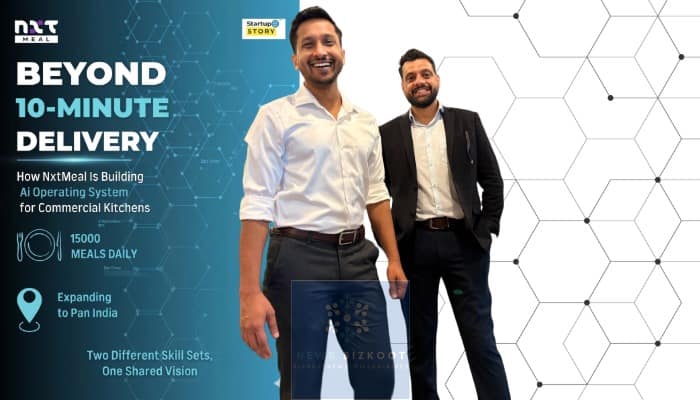
India’s food‑tech landscape has moved through a series of defining contests—first restaurant aggregation, then cloud kitchens, and now quick commerce, where the battle is fought over delivery speed and the funding needed to sustain that pace.
Milan Monappa and Sumeet Guleria chose to step aside from that race. Instead, they turned their attention to a largely overlooked segment of the food industry: the commercial kitchen itself, along with the procurement, planning, and production decisions that occur long before a meal leaves the premises.
That focus gave rise to NxtMeal, a Bengaluru‑based B2B food‑tech firm that leverages artificial intelligence to make commercial‑kitchen operations more predictable, efficient, and profitable at scale.
“While everyone is chasing a ten‑minute delivery, we are using AI to transform what happens inside commercial kitchens,” says Milan.
The B2B Gap Hiding in Plain Sight
NxtMeal did not spring from the first idea the founders entertained. Before kitchens, before AI, they operated a straightforward consumer food‑delivery platform—complete with their own app, riders, and customer base. On paper, it resembled every other Indian food‑delivery story of the time.
When they collided with Zomato and Swiggy, the economics stopped making sense. Winning that delivery‑speed contest would have required outspending rivals with deep‑pocketed war chests, a gamble with uncertain returns. They decided to stop running that race.
Looking away from delivery revealed a market that had quietly outgrown its existing infrastructure. Factories, tech parks, schools, hospitals, and manufacturing units collectively feed far more people each day than any delivery app could, yet they rely on manual systems that have remained unchanged for years.
No one was building solutions for that segment. That void became the opening for NxtMeal.
Two Founders, Two Skill Sets, One Shared Vision
The founding team reflects a deliberate split of expertise.
Milan Monappa, Co‑Founder and CEO, constructed the technological backbone—the AI systems and infrastructure that let kitchens run on data rather than guesswork.
Sumeet Guleria, Co‑founder and COO, brings operational experience from scaling high‑growth firms such as Swiggy, OYO, and Jumbotail. His background in enterprise sales and the discipline needed to expand rapidly without sacrificing quality complements Milan’s tech focus.
That complementary pairing proved vital because, across kitchens, the same problem kept surfacing: inventory, forecasting, and procurement decisions were still made manually. As operations scaled, waste rose, consistency slipped, and margins became harder to protect.
For Milan and Sumeet, this was not a personnel issue; it was a systems problem—one they believed technology was designed to solve.
The AI Layer Powering the Future of Commercial Kitchens
Artificial intelligence is often linked with software and consumer‑facing tools. NxtMeal applies it to a more tangible environment: the kitchen floor itself.
The company has built proprietary systems that forecast demand, calculate ingredient needs, optimise production planning, and monitor operational efficiency in real time. Instead of relying on a kitchen manager’s intuition, the platform analyses historical consumption data to determine what should be prepared, how much inventory is required, and where costs risk drifting.
According to the founders, the result is a level of consistency that traditional catering and dark‑kitchen models have historically struggled to achieve—performance that stays steady regardless of which kitchen or which manager is on duty on any given day.
Beyond Catering: Creating a Full‑Stack Food‑Tech Ecosystem
What began as an internal operational tool has grown into a broader software suite. Alongside its AI core, NxtMeal now offers ordering systems, queue‑management tools, kitchen‑management platforms, and workflow‑automation products. These are being adopted by operations outside the company’s own kitchens, creating a second revenue stream independent of catering.
The founders frame the company’s long‑term identity around this idea: NxtMeal is not merely a catering business; it is a Food AI platform capable of powering kitchen operations it does not directly own.
Scaling From Bengaluru to the Next Phase of Growth
NxtMeal currently runs six kitchens across Bengaluru, serving roughly 15,000 meals daily and generating close to ₹2 crore in monthly revenue.
The expansion plan works on two fronts. In Bengaluru, the goal is to grow from six to fifteen kitchens over the next two years. Simultaneously, the company is entering Hyderabad with two kitchens by December—its first move outside Bengaluru—bringing the AI‑driven kitchen model to a new city.
On the technology side, NxtMeal has developed its own ordering, queue‑management, and kitchen‑management software. These products now stand apart from the core catering business and have begun generating independent revenue, a stream the founders intend to grow alongside kitchen expansion.
The Bet Behind the Bet
Most of food‑tech still asks the same question: How fast can a meal reach someone? Milan and Sumeet posed a different one: What if speed was never the real problem? What if the larger opportunity lay not in the last mile, but in the kitchen everyone passes to get there?
That conviction is what NxtMeal is built on—not a faster way to deliver food, but a smarter way to make it: forecasting demand before it appears, catching waste before it accumulates, and keeping quality steady across an expanding kitchen network. It’s a quieter disruption, one that doesn’t flash in a delivery‑time alert but shows up every time a meal is consistent, on time, and priced right.
While the rest of the industry races toward the consumer’s door, Milan Monappa and Sumeet Guleria remain in the kitchen, confident that’s where the true food‑tech story was always meant to be written.


