Beyond the Plow: Why the Future of Farming Is Pure Entrepreneurship
6 min read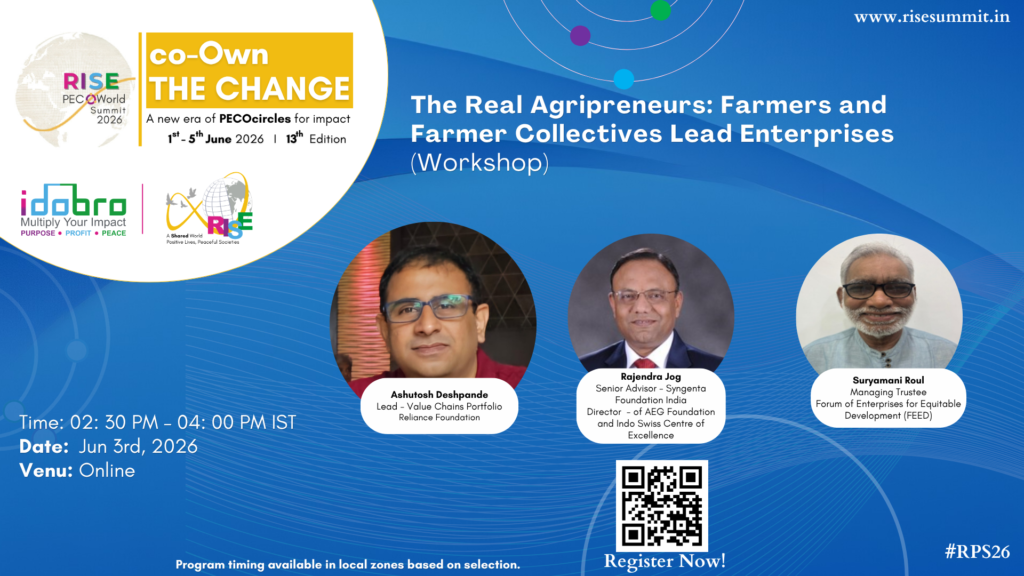
India’s marginal farmers earn roughly ₹80,000 a year on average — a stagnation panelists called a systemic failure to capture value, not a productivity problem. Farmer Producer Organizations (FPOs) post 20–30% survival rates, far outpacing the roughly 1% survival rate often cited for urban tech
startups The session’s core thesis: the rural economy must shift from a price-taking “Farm-to-Market” model to a value-creating “Farm-to-Enterprise” model.
A ₹700 fertilizer dispenser from Karnool district, Andhra Pradesh — later scaled with Reliance Foundation support — cuts fertilizer use by 25%.
In India, we face a profound agricultural paradox: we celebrate the farmer in our cultural spirit, yet we have historically neglected them on the national balance sheet. For decades, agriculture has been framed as a “culture” or a survival activity rather than a sophisticated enterprise. This framing has consequences. Despite our deep-rooted connection to the land, the average income of marginal farmers remain stagnant at approximately ₹80,000 per annum — a figure that represents a systemic failure to capture value. To move beyond this stagnation, the panel argued, India must pivot from viewing the farmer as a mere producer to recognizing the “Agripreneur” as a central driver of dignity and national growth.
The Original Risk Managers: Farmers as Entrepreneurs
The modern terminology of the “startup” often centers on urban tech hubs, yet farmers are the world’s original practitioners of bootstrapping. As synthesized by sector leaders Ankush Singh and Rajendra Jog, every sowing season is essentially a high-stakes production launch. A farmer functions simultaneously as a financier, labor manager, and production planner, all while navigating the volatile
variables of climate uncertainty and market flux.
Dr. Sudhir Kumar Goel offered a sharper, policy-level framing during the session: agriculture is the “highest risk-taking proposition” in th economy. When a farmer manages capital and risk under these extreme pressures, he argued, they are not just performing a survival activity – they are managing a complex business. The challenge for policymakers now is to treat these actors as the business leaders they already are.
Beyond Cultivation: The Architecture of the Farm-to-Enterprise Model
Panelists pointed to a structural evolution underway in the rural economy: a shift from a rudimentary “Farm-to-Market” model to a more obust “Farm-to-Enterprise” model. The distinction is vital. In the
former, the farmer is a price-taker selling raw commodities; in the latter, the farmer becomes a value-creator. The architectural shift involves moving beyond simple cultivation to managing data, building
recognizable brands, and restoring ecosystems to create sustainable rural wealth.
“The real question is not if or can farmers become businessmen. But the real question is, can agribusiness survive if farmers do not become businessmen?” — Rajendra Jog
The Resilience Quotient: FPOs vs. Tech Startups
The prevailing narrative often paints Farmer Producer Organizations as struggling entities. The session offered a counter-intuitive read of the data: while urban tech startups suffer high mortality rates — often cited near a 1% survival rate — FPOs demonstrate a markedly higher resilience quotient.
Venture Type Approx. Survival Rate
Urban Tech Startups ~1% Farmer Producer Organizations (FPOs) 20%–30%
Crucially, many FPOs have already surpassed the psychological threshold of a one-crore-rupee turnover, proving that collective entrepreneurship is a viable vehicle for scale. The sustainability of these organizations, panelists noted, rests on three strategic pillars:
Governance over elite capture: building the capacity of the Board of Directors to resist capture by professionals or local power brokers, keeping the enterprise democratically accountable.
Bootstrapping and blended finance: resilient FPOs prioritize market-led growth, blending government grants, market loans, and reinvested profits into stronger balance sheets than subsidy-only models.
Local income multipliers: the FPO acts as a catalyst for the local economy, keeping wealth within the community and generating a multiplier effect for village-level employment.
Ashutosh Deshpande added a workforce-development dimension, describing what he called “apprentice-based learning.” Unlike theoretical classroom training, he said, rural leadership is forged through real-worl negotiation — learning how to handle disgruntled customers and pitch
businesses through hands-on experience.
Recognizing the “Invisible” Agripreneurs
Marginal farmers constitute 68% of India’s farming population, yet many of the most active entrepreneurs within this group remain “invisible” in official data, panelists said. The session highlighted a surge in female-led service provision, with “Drone Didis” and “Kisan Didis”
emerging as specialized actors in the value chain.
To formalize this progress, Suryamani Roul advocated for a comprehensive Agri-Registry” or “AgriStack.” This digital infrastructure would categorize agripreneurs not just by land size but by value chain — segregating specialists in apple, mango, or paddy, as well as the high-growth allied sectors of animal husbandry, fishery, and livestock. Such a registry, he argued, is the first step toward fixing last-mile delivery of credit and technology.
The Power of Local Innovation: The ₹700 Solution
A recurring theme of the session: business transformation in agriculture doesn’t always require fancy technology. In Karnool district, Andhra Pradesh, a farmer-innovator developed a fertilizer dispenser that costs a mere ₹700 to produce. The device lacked any Series A funding, but its impact was undeniable — it reduces fertilizer consumption by 25%. Recognizing the value of this grassroots solution, the Reliance Foundation helped scale the innovation to other districts and states,
illustrating that farm transformation often means re-engineering existing tools to meet local needs rather than importing high-tech fixes.
Conclusion: The Dignity of Innovation
The future of India’s food systems depends on bridging the gap between rural production and national prosperity. As Dr. Goel reminded the session, FPOs were never meant to replace the existing value chain, but to stand firmly within it as strong, unexploited players. The goal, panelists agreed, is a partnership model where the farmer is no longer a “beneficiary” but a “CEO.”
A CEO-farmer does not just grow food; they manage data, restore the environment, and lead their community toward prosperity. The session closed on a pointed question for India’s policymakers and investors alike: are we ready to treat the farmer as a CEO rather than a beneficiary?
FAQ
What is the “Farm-to-Enterprise” model?
It’s a shift from selling raw commodities as a price-taker (Farm-to-Market) to building data, brands, and ecosystem value as a value-creator (Farm-to-Enterprise).
Why do FPOs outperform tech startups on survival rate?
Panelists pointed to governance discipline, blended finance over subsidy
dependence, and a local income-multiplier effect that anchors FPOs in
real community demand.
What is an “AgriStack” or “Agri-Registry”?
A proposed digital registry that categorizes agripreneurs by value chain — not just landholding size — to improve last-mile delivery of credit and technology.
By Amita Nene | amita.nene@newsbizkoot.com
Agriculture India
Disclaimer: This article reflects panel commentary and synthesized insights from session speakers; figures cited are as presented during the session.
Copyright: Content is copyrighted to Newsbizkoot.com Digital
Publications. All Rights Reserved. 2026-27
About Author