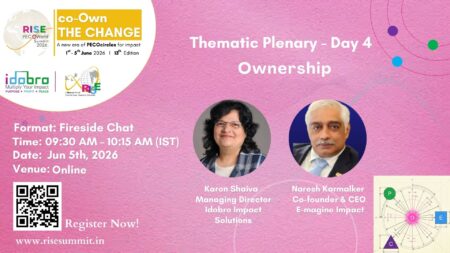
Forget MSMEs: Why the ‘3C Passport’ Is the New Currency of Global Impact
6 min read
The RISE PECOWorld Summit 2026 introduces the “3C Passport” — a Cause, Community, and County framework — as a replacement for the MSME label, living social enterprises a borderless identity built on impact rather than revenue size alone.
The global impact space is currently paralyzed by a “convergence crisis.” We have enough white papers to paper the planet, but we are starving for ground-level execution. Talk is cheap; actual systemic change is hard. We find ourselves trapped in an embarrassment of riches when it comes to content, yet the bridge between a visionary idea and a scalable solution remains precariously thin.
The RISE PECOWorld Summit 2026 is the antidote to this dialogue fatigue. This 13th edition marks a radical departure from “business as usual,” moving beyond the podium and into the “Architecture of Convergence.” It is a call to turn fleeting conversations into concrete projects that live and breathe between one summit and the next.
As we dissect the Entrepreneurship pillar of the PECO framework — Partnership, Entrepreneurship, Community, Ownership — six transformative insights emerge to redefine what it means to be an impact-driven professional.
1. Your Business Needs a “Passport” (The 3C Model)
Traditional economic metrics are failing the social sector. Labels like MSME (Micro, Small, and Medium Enterprises) focus strictly on revenue and size, completely ignoring the Triple Bottom Line approach. At RISE, the conversation has shifted toward WSG Entrepreneurship — Women, Social, and Green.
To navigate this new landscape, every enterprise needs a 3C Passport. This isn’t just a label; it’s a mechanism that moves an enterprise beyond the static MSME definition and into a global category of value.
The three Cs define an identity that travels without borders:
Cause: The specific problem or systemic issue you are solving.
Community: The vulnerable or target groups you serve (e.g., people with disabilities, senior citizens, or women).
County: The precise geographic location where your impact is rooted. This framework is superior because it replaces ambiguity with radical clarity. When your Cause, Community, and County are articulated, you provide an immediate roadmap for potential partners.
“When you are able to articulate this clearly, there is no doubt in anybody’s mind as to how or why they want to partner with you… it allows others to understand more easily how they can partner.”
— Karon Shaiva
2. The “Agripreneur”: Redefining the World’s Most Critical Job
One of the most provocative shifts at RISE 2026 is the re-labeling of farmers as Agripreneurs. This is not a mere semantic tweak; it is a restoration of dignity. Entrepreneurship is, at its core, a mindset
dedicated to solving problems. Given that food security and climate action are the most critical challenges facing our species, the farmer is the ultimate entrepreneur.
The Agripreneur manages a level of complexity that would break most tech founders. They must navigate volatile market pricing, intricate value chains, and grueling logistics — all while contending with “storms out of nowhere” and the unpredictable brutality of climate change.
Recognizing them as Agripreneurs acknowledges their right to the same institutional support, dignity, and capital access afforded to any other high-growth business owner.
3. AI and the “Pioneer Gap” in Philanthropy
In the post-COVID landscape, technology is the primary tool for converting adversity into opportunity. The RISE summit highlighted a revolutionary shift in capital: philanthropy is moving into the
ownership space.
This is a critical evolution meant to bridge the “Pioneer Gap” — that high-risk, early-stage valley of death where traditional banks and even risk-averse angel investors refuse to tread. To facilitate this, the
PECOWorld platform is now AI-enabled. We are moving toward sophisticated algorithms that automate the connection between these social enterprises and the resources they need. By using AI to create these automated collaboration links, we ensure that no “pioneer” is left to struggle in isolation.
4. Why “Human-Centered Design” Is Often Doing It Wrong
The summit offered a scathing critique of traditional design thinking. For too long, “human-centric” design has been synonymous with “whiteboard empathy” — placing a person in a visual circle and drawing processes around them. This treats the human as a passive subject, not a participant.
RISE introduces Human Design Thinking as a proprietary methodology. In this model, the person is not a centerpiece to be observed; they have an active, operational role. Every process and step is built by
anticipating the person’s specific reactions and actions. We are moving from designing for people to designing with them, treating them as equal operational partners rather than passive recipients of a service.
5. The Architecture of Convergence: Death of the “Stuck” WhatsApp Group
We have all experienced it: a high-energy meeting ends, a WhatsApp group is formed, and then… it becomes a “silent graveyard” of attempted collaboration. The Architecture of Convergence is the summit’s structural solution to this stagnation.
Through PECOCircles and PECONet, RISE provides the one thing most collaborations lack: visibility. These structures allow the global community to see what is being attempted in real-time, enabling others to join in and add value. It transforms a closed, transactional dialogue into an open, achieving community. This architecture ensures that change doesn’t stop when the summit ends; it provides the scaffolding for impact to happen year-round.
6. Radical Inclusivity: Bridging the Technology Divide
True convergence requires a physical presence where the technology divide is most acute. This is why RISE 2026 emphasizes offline, “radical inclusivity” in areas like Mankhurd, a low-income housing pocket in Mumbai. The inauguration of a community library here recognizes that books remain a vital resource for those on the wrong side of the digital split.
This holistic approach also extends to self-defense training for girls. By addressing the root cause (the mindsets that perpetuate violence) while simultaneously providing immediate solutions (the physical ability to protect oneself), RISE demonstrates how to bridge the gap between long-term systemic change and urgent, ground-level needs.
“The solution to violence against girls is not to keep them locked up at home. The solution is to empower them to protect themselves. Of course, the root cause is to make sure violence does not enter the minds of those who want to perpetuate it… but along with that, this is also a very important solution.”
— Karon Shaiva
Conclusion: From Participant to Collaborator
The evolution of social entrepreneurship demands a personal journey from being an attendee to being a contributor, member, and collaborator. The PECO framework provides the structure, but you provide the soul.
As you engage with the PECOWorld platform, you will be asked to take a Persona Test. This is not about your job title; it is about how you show up in a collective setting. Are you a Partner (steward of resources), an Entrepreneur (solver of problems), or a Citizen (mobilizer of community)?
Understanding your dominant persona is the first step toward effective convergence. The world’s problems belong to all of us. We now have the innovations, the resources, and the structure to solve them. The only remaining question is: are you ready to converge?
Frequently Asked Questions
What is the 3C Passport?
A framework introduced at RISE PECOWorld Summit 2026 that identifies a social enterprise by its Cause (the problem it solves), Community (who it serves), and County (where its impact is rooted), replacing revenue-based labels like MSME.
What is an Agripreneur?
A term used at RISE 2026 to reframe farmers as entrepreneurs who manage market risk, logistics, and climate volatility, deserving the same institutional support and capital access as any high-growth founder.
What is the “Pioneer Gap”?
The high-risk, early-stage funding gap where traditional banks and angel investors are reluctant to invest. RISE 2026 discussed how AI-enabled philanthropy on the PECOWorld platform is being used to close this gap.
What is Human Design Thinking?
A methodology introduced at RISE 2026 that positions people as active operational partners in designing solutions, rather than passive subjects observed from the outside, as in conventional human-centered
design.
What are PECOCircles and PECONet?
Structures within RISE’s “Architecture of Convergence” that give collaborations ongoing visibility, allowing the global community to track and join projects between summits rather than losing momentum after the event ends.
#Entrepreneurship, #Impact Investing, #Human Design Thinking
Disclaimer: This article is based on discussions and sessions at the RISE PECOWorld Summit 2026 and is intended for informational purposes only.
By Amita Nene | amita.nene@newsbizkoot.com
Content is copyrighted to Newsbizkoot.com Digital Publications. All
Rights Reserved. 2026-27.

About Author