USBRL: Inside India’s Greatest Railway Engineering Project
7 min read
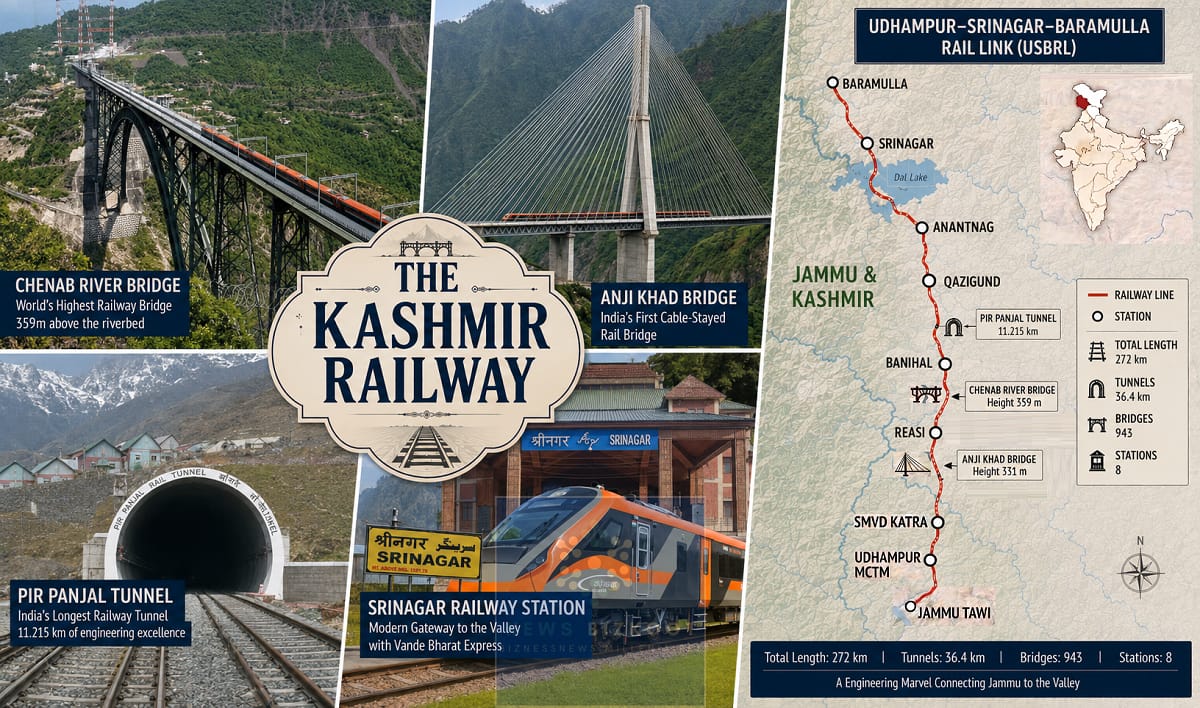
The USBRL spans 272 km through the Himalayas, includes 36 tunnels covering 119 km, 943 bridges, the world’s highest railway arch bridge over the Chenab River at 359 metres, and India’s first cable-stayed
railway bridge at Anji. Built over three decades at a cost of ₹43,780 crore, it is the most technically complex railway project ever completed in India — and one of the most difficult in the world.
Thirty years. ₹43,780 crore. 272 kilometres of track through some of the most hostile terrain on the planet. The Udhampur–Srinagar–Baramulla Rail Link (USBRL) is the railway project that India spent three decades trying to complete — and when it finally opened in June 2025, it did so with two world records and a bridge that stands taller than the Eiffel Tower.
Now the Vande Bharat Express runs Jammu to Srinagar on this line in under five hours. But the train is almost the easy part of the story. The engineering that makes the journey possible is the real thing worth
understanding.
Why Building a Railway Through the Himalayas Is So Hard
without warning, rock formations vary dramatically within short distances, and seismic activity in the region is some of the highest in the world (Zone 4 and Zone 5 — the most dangerous categories).
Add to that the weather: sub-zero winters that can freeze water in pipelines, snowfall that can bury roads for weeks, and winds in some valleys that regularly exceed 200 km/h. Roads go through all of this and
frequently fail. A railway has to be built to a different standard — it needs to be not just accessible but reliable. The whole point of a train in this terrain is that it keeps running when everything else has
stopped.
That’s what made the USBRL so difficult — and what makes it, when you look closely, so extraordinary.
The Numbers That Actually Tell the Story
Specification | Detail
Total route length | 272 km
Total project cost | ₹43,780 crore
Number of tunnels | 36
Total tunnel length | 119 km
Number of bridges | 943
Highest bridge | Chenab Railway Bridge — 359 m above riverbed
Longest tunnel | T50 — 12.77 km
Seismic design rating | Zone 5 (highest category)
Wind resistance | Up to 266 km/h
Designed lifespan | 120 years
Project start | Late 1990s
Completed and operational | June 2025
Nearly 97.42% of the Katra–Banihal section — the hardest 111 km stretch — passes through either a tunnel or a bridge. Out of every 100 km of track in that section, fewer than 3 km are on the ground. Everything else is either underground or in the air.
The Chenab Railway Bridge: World’s Highest Railway Arch
Key specs:
– Height: 359 metres above the Chenab riverbed — 35 metres taller than the Eiffel Tower (324 metres)
– Length: 1,315 metres, with 17 spans; main arch spans 467 metres
– Steel used: 29,800 metric tonnes
– Wind resistance: Designed for 266 km/h winds
– Seismic resistance: Zone 5
– Steel type: Blast-resistant steel and concrete — a first for Indian Railways
– Lifespan: Engineered for 120 years
– Designers: Consultants from Finland and Germany, in collaboration with
Indian engineers
When you cross it on the Vande Bharat, you cross it in about 30 seconds. The view downward — at the thin ribbon of the Chenab River — lasts exactly as long as that window allows.
The Anji Khad Bridge: India’s First Cable-Stayed Railway Bridge.
Anji Khad Bridge specs:
– Height: 331 metres above foundation (193-metre pylon)
– Total length: 473 metres
– Cables: 96 cables (originally designed with 48, expanded during construction)
– Steel used: 849 metric tonnes in cables
– Pylon: Single pylon at 193 metres — one of the tallest bridge pylons in India
– Wind resistance: Up to 225 km/h
– Seismic rating: Zone 5
– Design: Asymmetric cable-stayed — unique in Indian railway engineering
Inaugurated alongside the Chenab Bridge on June 6, 2025. The asymmetric
single-pylon design was chosen because the Anji River valley is too deep
and narrow for a conventional symmetric arrangement.
The Tunnels: 119 km Bored Through the Himalayan Rock
36 tunnels totalling 119 km. On some sections, you enter a tunnel and don’t see daylight again for several kilometres.
T50: India’s Longest Railway Tunnel
Every tunnel along the USBRL has a parallel rescue tunnel, connected to the main tunnel by cross-passages every 375 metres. This is a safety standard that even many developed-country railway systems don’t implement uniformly.
Rock and Geology Challenges
– Squeezing ground zones — rock pressure acts inward on the tunnel over time
– High-altitude permafrost in upper sections
– Multiple fault lines crossing the route
– Fractured rock zones requiring drill-and-blast methods
The seismic monitoring system installed along the entire USBRL route feeds real-time data to control systems. If seismic activity exceeds set thresholds, trains slow automatically.
The USBRL Section by Section
Section 1: Udhampur to Katra (25 km)
First section completed, opened in 2014. The Vande Bharat begins climbing into the foothills here.
Section 2: Katra to Banihal (111 km)
The engineering core of the project. The Chenab and Anji bridges are both here. The 97.42% bridge-or-tunnel statistic applies to this section. Last section to be completed.
Section 3: Banihal to Baramulla (136 km)
Opened in 2013. Includes the Banihal Tunnel (11.2 km) — now India’s second longest railway tunnel behind T50.
What Made the USBRL Take So Long
The project was sanctioned in 1997. It took 28 years to complete.
Four key reasons:
Geology kept surprising engineers. Himalayan geology is not fully mapped, and each new tunnel section revealed conditions that required re-planning.
The scale of innovation required. The cable-stayed railway bridge, blast-resistant bridge design, and tunnel seismic monitoring system were all firsts that had to be developed during the project itself.
Security and logistics. Building in a complex security environment affected contractor availability and materials transport.
Funding phasing. Budget was allocated across multiple Five-Year Plan periods, causing delays in early years.
The Vande Bharat on the USBRL: Specially Built for This Route
The Vande Bharat 2.0 running Jammu–Srinagar was designed specifically for the USBRL and Kashmir’s conditions:
– Anti-freezing water systems with silicon heating pads and self-regulating heating cables
– Heated driver windshield with embedded heating elements — a first for Indian Railways
– Extended warm-air ducts running to every restroom
– Kavach 4.0 safety system with GPS integration and automatic speed reduction
– 20-coach configuration expanded from the original 8-coach Katra–Srinagar service
The train operates in temperatures as low as -20°C.
FAQs: USBRL Engineering Project
How long did it take to build the USBRL?
Sanctioned in 1997, fully completed in June 2025 — approximately 28 years from sanction to full operationalisation.
What is the total cost of the USBRL?
Approximately ₹43,780 crore — one of the most expensive railway infrastructure projects in Indian history.
How high is the Chenab Bridge?
359 metres above the river bed — the world’s highest railway arch bridge, 35 metres taller than the Eiffel Tower.
What is the longest tunnel on the USBRL?
The T50 tunnel at 12.77 km — India’s longest railway tunnel, with a parallel rescue tunnel connected by cross-passages every 375 metres.
Is the USBRL operational throughout the year?
Yes. All-weather operation was a core design requirement. The route is not subject to the weather-related closures that regularly affect the Jammu–Srinagar highway.
Can tourists visit the Chenab Bridge?
The bridge is part of the operational railway and not open for independent visitor access. The best way to experience it is aboard the Vande Bharat Express.
The Bigger Picture
The USBRL is a 28-year statement about what India decided to prioritise. The Kashmir Valley is now connected to the Indian railway network for the first time — year-round, in all weather, on tracks that will last 120 years.
The bridge crosses a river 359 metres below. The tunnel bores through 12 km of Himalayan rock. The train climbs through it all, heated against -20°C, running on a safety system that monitors seismic activity in real time.
It took 28 years. It was worth the wait.
By Rajan Mathew | rajan.mathew@newsbizkoot.com
Category: Travel & Tourism
DISCLAIMER: The information provided in this article is for general
informational purposes only. All engineering specifications, costs, and
project details cited are based on publicly available information from
Indian Railways and the Press Information Bureau at the time of writing.
NewsBizkoot.com is not responsible for any discrepancies in technical
specifications that may arise from official updates or revisions after
the date of publication. Readers are encouraged to verify current
details at indianrailways.gov.in.
—
Content is copyrighted to Newsbizkoot.com Digital Publications. All
Rights Reserved. 2026 – 27


