Crossing the Ghats in Ten Minutes: First Drives Through the Mumbai–Pune Connecting Link
9 min read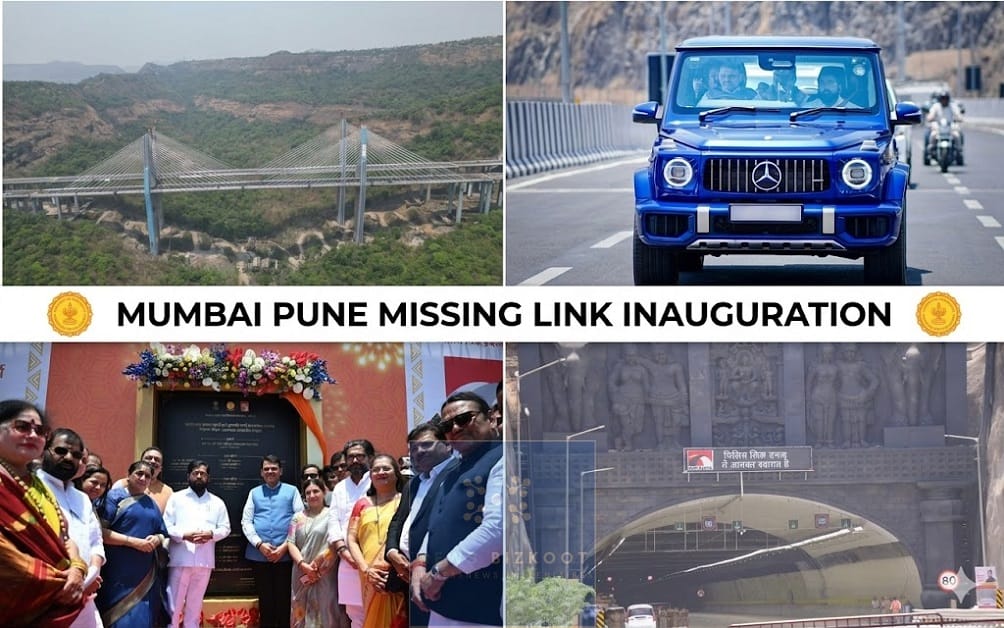
opening day — May 1, 2026 — found something they hadn’t expected: not
just a faster road, but a completely different kind of journey. Here is
what the first drives actually felt like.
Crossing the Ghats in Ten Minutes: First Drives Through the Mumbai–Pune
Connecting Link
The first thing you notice when you enter the tunnel is the light.
Not darkness — light. The 8.92 km bore is lit continuously, amber-white,
with a quality that feels closer to an airport terminal than anything
you’d associate with going underground. The walls are smooth, the lanes
are clearly marked, and the road surface is — after decades of Sahyadri
ghat abuse — impressively flat. Your first instinct, pulling off the
approach section from Khopoli, is to slow down. Not because the road
demands it. Because the experience is so unlike what your body expects
after a quarter century of ghat-section conditioning that you
momentarily don’t trust it.
Then you look at the speedometer. You’re already doing 90. And there is
nothing — no curve, no truck weaving, no sudden fog — between you and
the light at the other end.
That feeling is what opened on May 1, 2026.
What the First Day Looked Like
Maharashtra Day is always a big occasion in the state, but this year it
carried an extra charge. By mid-morning on May 1, social media was full
of the first drive-through videos — dashcam footage of the tunnel
approach, the entry portal, the long straight interior with its
repeating amber lights, and then the sudden burst of Sahyadri daylight
at the Kusgaon exit. Driver reactions across forums and video platforms
were consistent: Finally. This is unreal. Where did the ghat go?
CM Devendra Fadnavis inaugurated the project in the morning, received
the Guinness World Record certificate for the world’s widest underground
tunnel, and reframed the project’s name on the spot: not a Missing Link,
but a Connecting Link. The political theatre was standard. The
infrastructure underneath it was anything but.
Initially, only light motor vehicles were permitted. Heavy vehicles —
trucks, tankers, buses — will follow once full operational protocols are
cleared. So the first day was clean, fast, and uncrowded in a way that
peak-day reality will inevitably complicate. But as a proof of concept,
it was overwhelming.
The Tunnel Experience: What It’s Actually Like
Let me describe the drive as precisely as I can, because the numbers
tell part of the story but not all of it.
You approach from the Khopoli exit on the Mumbai side. The road curves
toward the tunnel portal — a wide, well-signed entry that is hard to
miss. The bore you’re entering is 22.33 metres wide. That is wide enough
to carry four lanes of traffic in each direction, with a central barrier
between the two directions of travel. You are, in effect, in a different
tube from the oncoming lane, though both are part of the same
twin-tunnel structure.
Inside, the first thing that strikes drivers after years of the old
six-tunnel network is the sheer scale. The Bhatan and Adoshi tunnels on
the existing expressway are impressive for their time. This is a
different category. The roof is high enough that there is no sense of
constriction. The width gives each lane genuine room. The LED lighting
system — air quality sensors trigger automatic ventilation and lighting
adjustments based on traffic density and tunnel conditions — means the
light quality shifts subtly as you progress, responding to what the
tunnel’s own systems are detecting.
At 100 km/h, the 8.92 km tunnel takes about five to six minutes. At 120
km/h — the posted maximum — it takes a little over four. You enter on
the Mumbai side, travel beneath the Sahyadri range and under Lonavala
Lake, and exit on the Pune side near Kusgaon. The elevation change that
made the old ghat section a test of brakes, clutch, and nerve is almost
entirely eliminated. You are not climbing a mountain. You are passing
through one.
The Viaduct: Where It Gets Dramatic
If the tunnel is the engineering marvel that gets the Guinness
certificate, the cable-stayed viaduct over Tiger Valley is the one that
gets the gasps.
Drivers emerging from the shorter 1.75 km tunnel on the approach
sequence find themselves on an elevated highway 180 metres above the
valley floor, on a cable-stayed bridge whose proportions are arresting
even at speed. The Sahyadri range spreads out in both directions — green
and steep and genuinely beautiful in the way the ghats always are from a
vantage point you couldn’t previously reach by road. The bridge uses
ultra-high-performance fibre-reinforced concrete girders, a technology
that allowed the spans to be built in challenging high-wind terrain
without the construction timeline of conventional concrete.
For drivers who have spent years on the enclosed, cliff-sided ghat road
— watching rock-faces instead of valleys — the viaduct section is a
genuine revelation. Several of the first-day videos show drivers slowing
(inadvisably, given the context) to take in the view. The highway
patrol’s early weeks on this section will involve a lot of “please keep
moving” announcements.
The Time Saving: What Drivers Are Actually Reporting
MSRDC’s official estimate is 20–25 minutes saved. Independent
assessments put it closer to 30 minutes. What drivers in the first 48
hours are reporting on forums and WhatsApp groups maps a consistent
picture:
Journey Point Old Route (via Ghat) New Connecting Link Difference
Khopoli to Kusgaon (section only) 25–35 min (off-peak) 10–12 min ~20 min
saved
Khopoli to Kusgaon (peak weekend) 60–90 min 12–15 min ~60–75 min saved
Total Mumbai to Pune (off-peak) ~2 hrs ~1 hr 30 min ~30 min saved
Total Mumbai to Pune (peak, pre-Connecting Link) 3–4 hrs ~2 hrs
(projected) ~1–2 hrs saved
The peak-day numbers are estimates — the first genuine festival-weekend
test of the Connecting Link will be the real benchmark. But the logic is
straightforward: the ghat section, which turned a 20-minute drive into a
90-minute crawl on bad days, no longer exists as a constraint. The
bottleneck has been eliminated, not managed.
What Lonavala Feels Like on the Other Side
Something unexpected emerged in the first-day reactions that nobody had
fully anticipated: Lonavala feels different from the Connecting Link
than it ever did from the ghat road.
On the old route, you experienced Lonavala by driving through it — the
congested market stretch, the exit backed up on Sundays, the coaches and
cars and bikes all competing for space on a road not designed for the
volume. On the Connecting Link, Lonavala is above you. You are beneath
it, in a tunnel that passes under Lonavala Lake, and when you emerge at
Kusgaon you are already past it, on the Pune side, with the hill town
somewhere up and to your left. Drivers heading to Lonavala will exit
earlier; drivers heading to Pune will bypass it entirely. The geography
has changed.
This is good news for Lonavala’s residents, who have been dealing with
the consequences of being the expressway’s most congested exit point for
24 years. It may complicate life slightly for the chikki shops and corn
stalls that depend on crawl-speed traffic for impulse stops. The honest
truth is that a town built around captive traffic that no longer has to
stop is going to need to adapt its visitor offer. The Connecting Link
will bring more visitors to the region — but fewer of them will stop
accidentally.
The Monsoon Test: June Will Tell the Real Story
Every regular Mumbai–Pune driver who has been through the ghat in heavy
rain knows what the monsoon does to that road. Landslides closing lanes
for days. Visibility dropping to 30 metres in the tunnel approaches.
Trucks jackknifed on wet gradients. The psychological experience of
driving a twisting mountain road in a Maharashtra monsoon downpour is
one that leaves a lasting impression.
The Connecting Link’s tunnel alignment bypasses all of this. Rock falls,
landslides, and fog — the three great seasonal enemies of the ghat
section — simply do not apply to an enclosed tunnel bore under the
mountain. MSRDC expects significantly fewer weather-related closures on
the new alignment. That is an understatement. The new alignment should
be almost entirely immune to the disruptions that have made the monsoon
months on the old ghat a perennial nightmare.
June 2026 will be the first real test. If the Connecting Link stays open
and dry while the old ghat section faces closures — as it almost
certainly will during heavy rain — the case for the ₹7,000 crore
investment will be made more vividly than any press release could
manage.
Early Verdict: This Is What the Road Was Always Meant to Be
The reactions from the first 48 hours of the Connecting Link’s operation
have a consistent emotional quality that goes beyond the practical
time-saving numbers. Drivers who have used this corridor for years —
some for decades — are describing something that feels less like a new
road and more like a wrong that has been righted.
The 200-year history of Mumbai–Pune road travel is a story of
connectivity being improved in stages: from horseback to stage coach,
from stage coach to railway, from NH-4 to expressway, and now from a
flawed expressway to a complete one. Each stage felt, at the time, like
the final answer. Each time, the answer turned out to be provisional.
This one might actually hold. The Connecting Link is not a patch on an
existing road — it is the missing structural element of an expressway
that was always meant to bypass the ghat, but never quite did. The
engineering details of what was built justify the description. The world
record is not incidental. The cable-stayed bridge is not decoration. The
8.92 km tunnel is not just long — it is the correct engineering solution
to a problem that has been causing accidents and delays for 24 years.
Whether the driving culture challenges of the Mumbai–Pune corridor get
resolved alongside the infrastructure upgrade is a separate and harder
question. But on the evidence of May 1, 2026 — the inaugural drives, the
first videos, the first clean, fast, curve-free runs through the
Sahyadri — something has genuinely changed.
For the first time, the Mumbai–Pune Expressway is complete. Nothing is
missing. Everything is in place.
Explore more on India’s roads and travel infrastructure on
NewsBizkoot.com.
Related Articles in This Series
The Connecting Link: How Maharashtra’s ₹7,000 Crore World Record Tunnel
is Rewriting the Mumbai–Pune Drive
From Horseback to 120 km/h: 200 Years of Mumbai–Pune Road Travel
The Road We Refuse to Respect: India’s Expressway Driving Culture Has a
Serious Problem
drive, Mumbai Pune tunnel first drive, Lonavala tunnel experience, Tiger
Valley viaduct, Maharashtra Day 2026 expressway, MSRDC Connecting Link
open, Mumbai Pune travel time 2026, Khopoli Kusgaon tunnel, India world
record tunnel drive, Roadways & Transport India, Mumbai Pune Expressway
May 2026
Disclaimer: The information published in this article is based on
publicly available sources, official government and MSRDC
communications, and verified media reports at the time of writing.
Driver experience descriptions are based on publicly reported accounts
from the inaugural day of opening. NewsBizkoot.com makes every effort to
ensure accuracy but does not guarantee completeness or currency of the
information. Readers are advised to verify details independently before
making travel decisions.
Sources: Wikipedia – Mumbai–Pune Expressway (en.wikipedia.org) | The
Print – Guinness World Record report (theprint.in) | MSRDC official
project documentation (msrdc.in) | StayVista Research (stayvista.com)
By Rajan Mathew | rajan.mathew@newsbizkoot.com
drive, Mumbai Pune tunnel first drive, Lonavala tunnel experience, Tiger
Valley viaduct, Maharashtra Day 2026 expressway, MSRDC Connecting Link
open, Mumbai Pune travel time 2026, Khopoli Kusgaon tunnel, India world
record tunnel drive, Roadways & Transport India, Mumbai Pune Expressway
May 2026
Disclaimer: The information published in this article is based on
publicly available sources, official government and MSRDC
communications, and verified media reports at the time of writing.
Driver experience descriptions are based on publicly reported accounts
from the inaugural day of opening. NewsBizkoot.com makes every effort to
ensure accuracy but does not guarantee completeness or currency of the
information. Readers are advised to verify details independently before
making travel decisions.
Copyright: Content is copyrighted to Newsbizkoot.com Digital
Publications. All Rights Reserved. 2026-27
By Rajan Mathew | rajan.mathew@newsbizkoot.com


